Jim McGreevey is Governor Christie’s Ethical Compass?
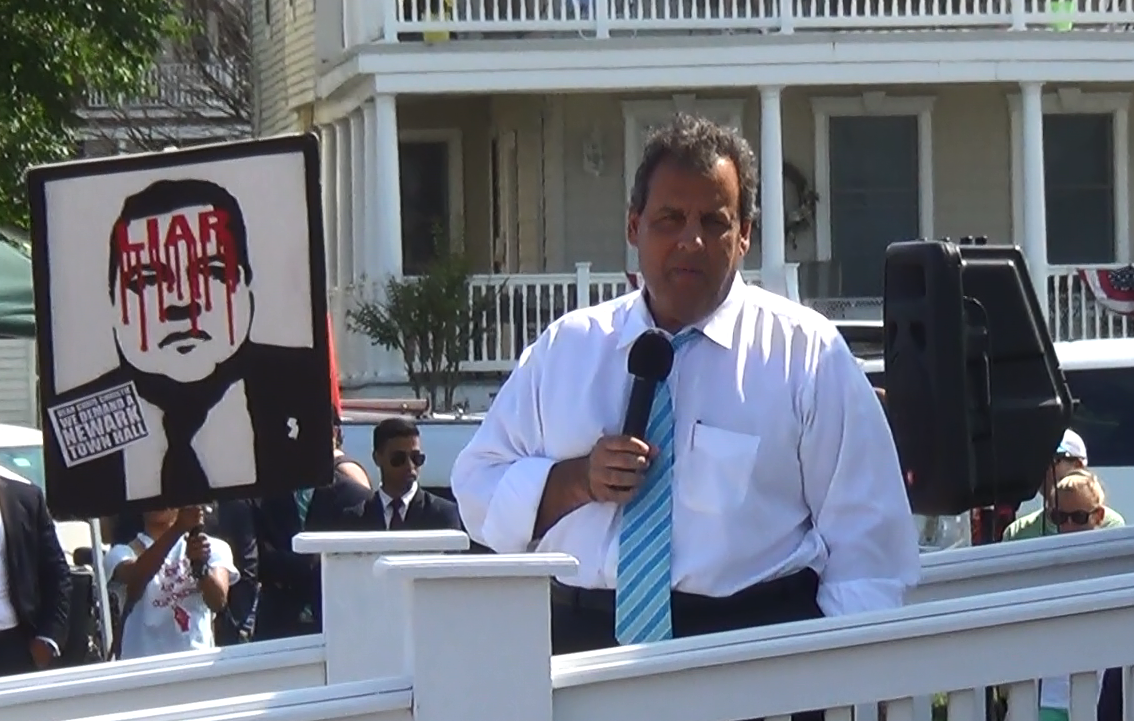
Govenor Chris Christie at his Belmar Town Hall on July 31. Photo by Art Gallagher
In the summer of 2004, U.S. Attorney Chris Christie had Governor Jim McGreevey on the ropes. McGreevey was “State Official #1,” an unindicted co-conspirator in a pay for play scheme that nabbed Democratic fund-raiser David D’Amiano. A few weeks later McGreevey was resigning, purportedly because he was a “Gay American” who gave his boyfriend an important homeland security job that he wasn’t qualified to perform.
Yesterday, a decade later, Governor Christie is hanging his hat, and his orange sweater, on a McGreevey Executive Order that exempts the Governor from New Jersey’s ethics laws against accepting gifts.
Chris Christie marched into Trenton promising to turn the place upside down. Five years later McGreevey is Christie’s ethical compass. Not the man McGreevey has become over the last 10 years. Christie’s ethical compass is the man he investigated and probably could have indicted and convicted. To paraphrase Christie on the stump for Mitt Romney two years ago, something got turned upside down in Trenton, but it wasn’t the culture of government that Christie promised he would impact and overturn.
About the best thing we can say about Christie accepting gifts of travel on private jets and seats in owner’s boxes at NFL games is at least it was family friendly entertainment with the cameras running, unlike the alleged entertainment U.S. Senator Bob Menendez flew off to on a friend’s private jet.
The next stop on Governor Chris Christie’s “No Pain, No Gain” tour on the Jersey Shore will be held in Belmar next Wednesday, 3PM, at the Huisman Gazebo, 500 Ocean Ave.
Christie kicked off the tour in Long Beach Island on Tuesday where he said he would be proposing a plan to save New Jersey from bankruptcy by the end of this summer. The work-in-progress plan will focus on reducing pensions and benefits for public workers.
“There are going to be some really difficult things,” Christie said. “There’s not a lot of places left to do things except to look at a whole different variety of ways to reduce benefits or to increase contributions by employees.”
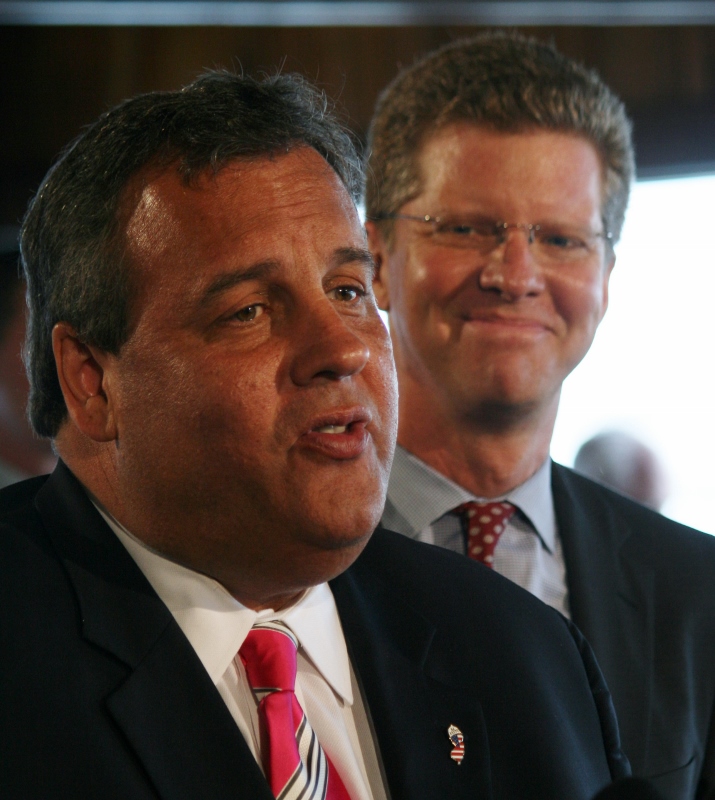
Governor Chris Christie and HUD Sec Shaun Donovan in Highlands, April 29, 2013
Now that Governor Chris Christie has completed his victory lap with appearances on all four network Sunday morning talk shows, the whole world thinks he’s running for president.
His presidential message of getting things done in a bi-partisan manner is compelling given the current national political environment. If the presidential election was next November, I think he would beat Hillary Clinton or any Democrat.
But the presidential election is in 2016. Before running for president Christie has a year or two governing New Jersey and a year, 2014, as Chairman of the Republican Governors Association.
2014 will be a busy year for Christie. In addition to the undefined “big things” he said he will accomplish in his second term, there are 36 gubernatorial seats (38 if you consider the U.S. territories of Guam and the Northern Mariana Islands) up in ’14. 19 (20 if you count Guam) of those seats are currently held by Republicans.
In New Jersey, much of Christie’s first term agenda remains undone. Tax cuts, “the property tax toll kit,” civil service reform, education reform, reshaping the State Supreme Court, and gutting COAH are all incomplete. Rebuilding from Superstorm Sandy is his mission. Much of New Jersey is still hurting one year out from the storm.
If Christie can cross off most of his New Jersey agenda from his to do list, get the remaining Sandy survivors back into their homes, and pick up some gubernatorial seats next year, the 2016 Republican presidential primaries will not be much of a challenge. No other GOP contender would be able to match Christie’s “I can get the job done and I know how to win” message.
Sweeney wants to pay for beach safety and maintenance by getting rid of cops and dpw workers
Photo credit: www.SignsByTheSea.com
MMM has called Senate President Steve Sweeney (D-Gloucester) three times since he jumped on board with the Senator Mike Doherty (R-Warren) in sponsoring legislation that would ban shoreline municipalites from selling beach badges or imposing other user fees to pay for lifeguards, beach cleanup and policing, if those towns accept federal and state money to rebuild from the destruction of Hurricane Sandy. He hasn’t called back. Steve Sweeney is a kitten. Kitten, kitten, kitten!
Given that he won’t talk to us, we’ll have to judge Sweeney’s crusade for free sand in his ass by what others report he says. The Senate President invited himself to a meeting with the Asbury Park Press Editorial Board earlier this week to make his case for free beaches.
“You don’t charge me to breathe air, why are you charging me to sit on a beach?”
We should be grateful that the top elected Democrat in New Jersey hasn’t figured out how to tax breathing (yet). But really now, our Senate President thinks breathing air (as opposed to grapefruit juice?) is analogous to sitting on a beach? That is something we should be concerned about, especially since this guy is considering a run for governor.
Sweeney told the APP that Belmar and the other shore communities that impose beach user fees should cover those costs by consolidating police forces and departments of public works. He said he would “beat up mayors down the shore” to make it happen “because its not acceptable, you know, to charge beach fees.”
Belmar Mayor Matt Doherty took Sweeney’s first beating:
“I asked (Doherty), how many people live year-round in his town,” Sweeney said. “He’s got a one-square mile town, he’s got 5,800 people. Now, could we run a shared police department? I met his public works director today, could we run a shared public works office?”
“You guys know how I feel about shared services,” Sweeney told the APP. We don’t know if the APP knows how he feels, but MMM thinks Sweeney is thwarting shared services and other methods that municipalities could use to reduce the size and cost of local government. If Sweeney was serious about property tax reduction and more efficient local government he would have passed Governor Christie’s property tax tool kit.
The fiscal crisis in New Jersey’s governments and schools will continue through 2017 as a result of a $13 billion revenue shortfall, ($8 billion on the state level, $5 billion on the local, county and school levels combined) according to a report, Facing Our Future, released by the Council of New Jersey Grantmakers. (CNJG)
The report says New Jersey will face a gradual cut in government services of 20%. Increased classroom sizes, from 22 to 28, less police officers and the elimination of services all together.
CNJG recommends solutions we have all heard before. Shared services, consolidations, more county government and less municipal government, county administration of schools.
One thing that is not clear from the write-ups. $7 billion of the $8 billion state revenue shortfall will be pension contributions negotiated by Governor Christie and the Democratic legislature in last years “landmark” pension and benefit reform bill.
One solution not recommended in the report….break the government employees unions’ control of our government.
In 2010 the unions said no to give backs. Thus, New Jersey suffered increased class sizes and police layoffs in our cities. Crime continues to rise in Newark and Camden, but our elected officials can’t do anything about that because the unions control how many police officers can be hired given the money available to pay them.
New Jersey pays unemployment benefits to laid off police officers not to patrol the streets of our cities, while the high paid officers who kept their jobs do the best they can. There are less extreme examples of needless service cutbacks throughout the state.
Practically speaking, there is no question that New Jersey’s public employees control the government. Not the people. Not the elected officials.
New Jersey’s fiscal crisis could be solved easily if the law of supply and demand were applied to the labor market for government workers. Until that happens, if it ever happens, we will continue to pay more for less.
It doesn’t matter how we restructure government so long as the employees are in charge.
“If you want to survive in this business, keep your mouth shut.”
That was the first piece of advice I got as a newly elected member of my county’s governing board in the 1990s. I was an idealistic political neophyte. My self-appointed mentor was a jaded party boss, one of the longest-serving political strongmen in the state. To me, accountability was key to integrity. But among his sycophants and hangers-on, this was a silly notion for suckers, fools or wimps.
Assemlywoman Amy Handlin in no sycophant or hanger-on. Nor is she a sucker, fool or wimp.
In her hard hitting ebook published by HarperCollins, Handlin tells of her encounters with Monmouth County and New Jersey “Crony Capitalists”, and gives Tea Party members and other citizen activists and blueprint on how to fight corruption at the lowest levels of government.
The essay includes tales of Hanlin’s career as a Middletown committeewoman, Monmouth County Freeholder, Assemblywoman, as well as references to corrupt practices throughout the nation.
Governor’s Recidivism Initiative Builds on State’s Strong Record with Expansion of Successful Drug Court Program, Improved Program Management and Coordination and Accountability for Results
Trenton, NJ – Taking action to build on the nationally recognized success of New Jersey’s prisoner re-entry, rehabilitation and prevention programs, Governor Chris Christie today outlined an initiative to help even more offenders get the support they need to successfully re-enter society, break the cycle of criminality and lead productive lives.
Governor Christie outlined this cross-departmental Administration initiative at Cathedral Kitchen, a community service organization that serves meals to those in need in Camden. Cathedral Kitchen operates a culinary arts program which gives job training to unemployed, unskilled, homeless citizens, re-entering prisoners and parolees, helping them transition to a successful, productive life once they are out of prison.
The Governor’s re-entry initiative includes the expansion of the state’s successful Drug Court Program, the appointment of a Governor’s Office Re-entry Coordinator, the creation of a Governor’s Task Force on Recidivism Reduction, an ongoing program assessment, and the development of a real time recidivism database. These changes will allow New Jersey’s re-entry and rehabilitation efforts and programs to work together, to be guided and properly resourced based on results, and to ensure effective programs are expanded to serve as many individuals as possible.
“New Jersey has a strong record of helping rehabilitate offenders and providing the services they need to be successful in society, significantly decreasing their likelihood of reoffending and improving public safety,” said Governor Christie. “But we can do better to make our re-entry programs more efficient, successful and effective – helping even more individuals get the support they need to change their lives for the better and break the cycle of offending and reoffending.”
Today, New Jersey is widely recognized as a national leader in reducing incidents of recidivism and reducing its prison population. The Pew Center on the States’ State of Recidivism report, “The Revolving Door of America’s Prisons,” identified New Jersey’s 11 percent recidivism decline as among the steepest declines for any state during the report’s study period, from 1999-2002 and 2004-2007. Since 1999, New Jersey’s prison population has declined more than 20 percent.
New Jersey spends over $225 million, not including over $40 million for the Drug Court Program, on its system of various re-entry and prevention programs across state government, but it is done in a decentralized manner with no mechanism to implement these resources strategically or measure program performance. The Governor’s initiative builds on the relative success of New Jersey’s existing system of re-entry programs in breaking the cycle of criminality and helping offenders lead successful lives after prison by addressing existing shortcomings and expanding those programs that are getting results.
Existing programs like the Drug Court Program, which serves as an alternative to incarceration for drug-addicted, nonviolent offenders, have already been effective in reducing recidivism rates among those they serve.
According to their October 2010 Drug Court Report, the rate at which drug court graduates are re-arrested for a new indictable offense is 16% and the reconviction rate is 8%. This is compared to re-arrest rates for drug offenders released from prison that stands at 54% with a re-conviction rate of 43%. According to that report, an average institutional cost per inmate is approximately $38,900, whereas the cost for an active drug court participant is roughly $11,379.
The Governor’s initiative will focus additional resources on this successful, demonstrably effective program and allow others to be similarly identified and prioritized to further reduce recidivism with programs that work.
Connecting offenders with the services they need to be successful back in society, whether it is recovery from substance abuse or the need for official identification, is critical to ending the cycle of crime. At present, a joint program between the state Department of Corrections and Motor Vehicles Commission (MVC) identifies qualified offenders on a quarterly basis, who are taken to MVC offices to obtain a driver’s license or non-driver identification card prior to the completion of their sentence. This program takes down impediments to successful re-entry resulting from the lack of official identification, which is often necessary to apply for a job, obtain housing, or connect with critical services like Medicare or food assistance.
“This initiative will build on our strengths by expanding highly successful programs like the Drug Court Program to get addicted offenders the underlying help they need, while also measuring and reforming or eliminating ineffective programs, and directing our resources in a smart, strategic and coordinated way to those programs that are making a positive difference in changing lives,” said Governor Christie.
First Lady Mary Pat Christie has made re-entry and prevention programs that help ex-offenders and recovering addicts return to normal life a priority. New Jersey’s innovative prevention and re-entry programs aimed towards at-risk populations have been highlighted by Mrs. Christie for their work in providing the building blocks to self-sufficiency and a pathway to achieve life success. Several of the initiatives have brought recognition to the Garden State as a national model for the progress made in this area. An overview of Mrs. Christie’s efforts in this area can be foundhere.
The Governor’s initiative includes the following components:
Expansion of the Drug Court Program
The drug courts presently accept approximately 1,400 new participants per year. Those new participants must volunteer for a sentence of drug court as opposed to incarceration. The Christie Administration initiative seeks to expand the drug court program by identifying eligible drug addicted non-violent offenders, providing them with clinical assessments to determine their suitability for drug court and sentencing those offenders to the drug court program regardless of their desire to enter the program.
This approach recognizes that one of the main impediments to treatment for addiction is the denial of addiction. Treatment systems that address the denial issue can ultimately be successful in treating a larger population of appropriate offenders. The Governor’s Re-entry Task Force will be tasked with working with the judiciary to facilitate a suitable expansion of this program beginning with two vicinages to be determined through this effort.
Governor’s Office Coordinator for Prisoner Reentry
A collaborative vision is necessary to improve what is a comparatively successful system of re-entry services. That vision includes, as a first phase, centralizing and providing a formal management structure on the current, decentralized system.
Governor Christie today announced that Lisa Puglisi, an attorney with more than a decade of experience with the Attorney General’s Office representing the Department of Corrections and later the State Parole Board, as his Coordinator for Prisoner Re-entry to convey and implement the Governor’s vision for an improved prisoner re-entry scheme. The Governor’s Coordinator for Prisoner Re-entry will co-chair the Task Force for Recidivism Reduction and serve as the principle policy adviser to the Governor on re-entry and recidivism reduction policy.
The Governor’s Task Force for Recidivism Reduction
There are more than just Corrections and Parole pieces to maintain and improve on the state’s public safety and prisoner re-entry mission. To address the current lack of coordination among the many treatment and reentry programs across state government, Governor Christie today signed Executive Order 83, creating the Governor’s Task Force for Recidivism Reduction.
The Task Force will be led by both the Chairman of the State Parole Board, James Plousis, and the Governor’s Coordinator for Prisoner Re-entry. Its members will include representatives from:
·Department of Corrections
·State Parole Board
·Motor Vehicle Commission
·Department of Human Services
·Department of Health and Senior Services
·Department of Military and Veterans Affairs
·Department of Law & Public Safety
·Juvenile Justice Commission
·Department of Community Affairs
The Task Force will develop recommendations for the Governor regarding how best to ensure the effectiveness and success of New Jersey’s efforts towards recidivism reduction, including an initial benchmarking study of existing program effectiveness and performance, and the development and implementation of a system to measure program effectiveness in an ongoing, real-time way.
Day-to-day implementation of the Governor’s initiative will be led by the State Parole Board Chairman Plousis, including the ongoing elements of the proposal such as collecting and analyzing performance data from various state departments for budgeting, programming and procurement purposes.
Ongoing Program Assessment and Measurement
The Governor’s Re-entry Coordinator and Task Force will work to facilitate a professional benchmarking assessment that will evaluate the effectiveness of all re-entry programs offered. The path forward to improve prisoner re-entry requires the Administration to gauge the successes, failures and the depth of gaps in program delivery – inside and outside of prison.
Programming gaps will be rectified by expanding existing, successful programs and hitting capacity thresholds, particularly relating to program delivery within prison. With the parallel development of the real-time recidivism database, this assessment will remain an ongoing accountability tool, allowing the Administration to identify and remediate or eliminate poor performing programs, ensuring that resources are directed to the most effective and successful programs.
Real-Time Recidivism Database
After the program assessment is completed, that data will be used to populate a database, which will allow the Administration to track outcomes for individuals and trends and level of effectiveness in programs in a real-time manner.
This project is currently in development through the efforts of the State Parole Board, Department of Corrections, the Juvenile Justice Commission, Department of Law & Public Safety, the Office of Information Technology and Rutgers University.
Republican Governor Chris Christie proposed pension and benefit reforms that would have resulted in a $300 million budget savings in the coming fiscal year and that actuaries said would have corrected the system.
Senate President Stephen Sweeney and Assembly Speaker Sheila Oliver, Democrats, gave Christie a “compromise” that results in a $9 million budget savings in the coming year and that actuaries say doesn’t go far enough.
Christie and the Republicans in the legislature are celebrating. The media is calling the bill a landmark reform.
The Democrats and their union benefactors are having a civil war.
There is a fifth dimension, beyond that which is known to man. It is a dimension as vast as space and as timeless as infinity. It is the middle ground between light and shadow, between science and superstition, and it lies between the pit of man’s fears and the summit of his knowledge. This is the dimension of imagination. It is an area which we callThe Twilight Zone.
Trenton, NJ – This evening, Governor Chris Christie, Senate President Stephen Sweeney, Assembly Speaker Sheila Oliver, Senate Minority Leader Thomas Kean, Jr. and Assembly Minority Leader Alex DeCroce released the following joint statement:
“After months of serious discussions, we are pleased to announce that we have reached agreement on legislation to reform our public pension and health benefits systems in New Jersey.
“The legislation to be considered tomorrow by the Senate Budget Committee and Monday by the Assembly Budget Committee protects taxpayers, saves the public pension system for current and future retirees, and enhances fairness and choice in our health benefits system.
“We all fully support this legislation and will work together to assure its passage by both houses of the Legislature and enactment into law no later than June 30, 2011.”